Salidrosid
| Strukturformel | ||||||||||||||||
|---|---|---|---|---|---|---|---|---|---|---|---|---|---|---|---|---|

| ||||||||||||||||
| Allgemeines | ||||||||||||||||
| Name | Salidrosid | |||||||||||||||
| Andere Namen |
| |||||||||||||||
| Summenformel | C14H20O7 | |||||||||||||||
| Externe Identifikatoren/Datenbanken | ||||||||||||||||
| ||||||||||||||||
| Eigenschaften | ||||||||||||||||
| Molare Masse | 300,31 g·mol−1 | |||||||||||||||
| Aggregatzustand |
fest[1] | |||||||||||||||
| Löslichkeit |
löslich in organischen Lösungsmitteln wie Ethanol, DMSO und Dimethylformamid[2] | |||||||||||||||
| Sicherheitshinweise | ||||||||||||||||
| ||||||||||||||||
| Wenn nicht anders vermerkt, gelten die angegebenen Daten bei Standardbedingungen (0 °C, 1000 hPa). | ||||||||||||||||

Salidrosid (Rhodiolosid) ist ein Glucosid des Tyrosols, das in der Pflanze Rosenwurz (Rhodiola rosea) vorkommt.[3] Es wurde in Verbindung mit Rosavin als eine der potenziellen Verbindungen untersucht, die für die mutmaßlichen antidepressiven und angstlösenden Wirkungen dieser Pflanze verantwortlich sind.[4][5] In einer Tierstudie wurde Salidrosid neben Tyrosol im erzwungenen Schwimmtest an Ratten als pharmakologisch wirksamer Inhaltsstoff identifiziert.[6] In fixer Kombination mit Rosavin, Rosarin and Rosin wirkte es stärker als allein.[6]
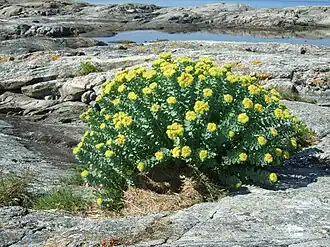
(Rhodiola rosea)
Einzelnachweise
- ↑ a b c Datenblatt Salidrosid, >95% bei Sigma-Aldrich, abgerufen am 11. Februar 2025 (PDF).
- ↑ Cayman Chemical: Salidroside (Rhodioloside, CAS Number: 10338-51-9), abgerufen am 11. Februar 2025.
- ↑ Yu Mao, Yan Li, Ning Yao: Simultaneous determination of salidroside and tyrosol in extracts of Rhodiola L. by microwave assisted extraction and high-performance liquid chromatography. In: Journal of Pharmaceutical and Biomedical Analysis. Band 45, Nr. 3, 5. November 2007, S. 510–515, doi:10.1016/j.jpba.2007.05.031.
- ↑ Marina Perfumi, Laura Mattioli: Adaptogenic and central nervous system effects of single doses of 3% rosavin and 1% salidroside Rhodiola rosea L. extract in mice. In: Phytotherapy Research. Band 21, Nr. 1, 2007, S. 37–43, doi:10.1002/ptr.2013.
- ↑ L. Mattioli, C. Funari, M. Perfumi: Effects of Rhodiola rosea L. extract on behavioural and physiological alterations induced by chronic mild stress in female rats. In: Journal of Psychopharmacology. Band 23, Nr. 2, 1. März 2009, S. 130–142, doi:10.1177/0269881108089872.
- ↑ a b A. Panossian, N. Nikoyan, N. Ohanyan, A. Hovhannisyan, H. Abrahamyan, E. Gabrielyan, G. Wikman: Comparative study of Rhodiola preparations on behavioral despair of rats. In: Phytomedicine. Band 15, Nr. 1, 25. Januar 2008, S. 84–91, doi:10.1016/j.phymed.2007.10.003.